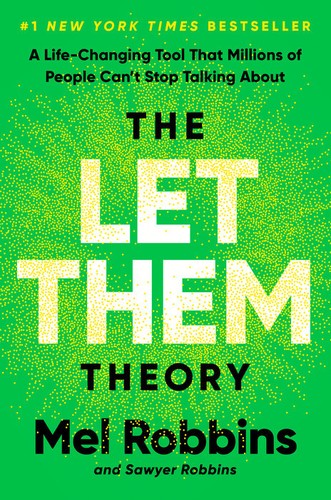
⏱ The book in 1 minute
- You waste energy trying to control what other people think, say, and do.
- "Let Them" means you stop fighting those things and accept them without a battle.
- "Let Me" is the second half: you put that freed-up energy into your own choices and actions.
- The book applies both steps to stress, fear, comparison, people pleasing, friendship, motivating others, and love.
- The goal isn't to stop caring. It's to care about the part you can actually change.
The big idea
Much of our stress comes from trying to manage things we were never in charge of: what other people think, how they feel, what they choose, and how they live. Mel Robbins, writing with her son Sawyer Robbins, argues that this habit drains time and energy we could be putting into our own lives. Her fix is a two-part mindset. First, Let Them: when someone acts in a way you can't control, consciously let them do it instead of fighting, fixing, or obsessing. Second, Let Me: turn your attention back to the one thing you do control, which is your own response, your choices, and your next step. The book applies this pairing to everyday pain points like fear of judgment, other people's moods, comparison, adult friendships, and relationships. The point isn't to stop caring. It's to stop over-functioning for other adults so you can take responsibility for yourself.
Key ideas
Two halves, not one
Let Them on its own can turn into passive resignation. The book insists it only works when paired with Let Me. You release what someone else is doing, then immediately ask what you will do about it. Releasing control is the first step. Taking action is the second, and it's the part that changes your life.
Other people's opinions belong to them
You will be misunderstood, judged, or talked about no matter how carefully you behave. Trying to steer every opinion keeps you small and anxious. Let them think what they think, then let yourself live by your own values and make the call you'd make if nobody were watching.
You don't have to manage anyone's emotions
When someone is disappointed, annoyed, or upset with you, the instinct is to rush in and fix it, often by giving up what you wanted. Robbins argues that adults are responsible for their own feelings. You can be kind and still hold your decision, and let them feel how they feel.
Calm your body before you choose
The book explains that stress reactions are physical and happen fast. Before you can apply Let Me well, you need to settle the stress response first, for example by pausing and breathing. Then you can choose a response instead of reacting on autopilot.
Turn comparison into information
Seeing someone else succeed can sting. Instead of resenting it, let them win, and use what you feel as a signal. Envy often points at something you want. Let Me becomes the question of what small step you could take toward it.
Adult friendships run on circumstances
Friendships often fade because life changes, not because someone did something wrong. Robbins highlights how much proximity, timing, and shared energy shape who stays close. Let people drift when life pulls them away, and let yourself take initiative to build new connections instead of waiting to be invited.
You can't make people change
Pushing, nagging, or rescuing another adult usually backfires and creates resistance. People change when they want to. Let them own their choices and consequences, and let yourself decide what you will accept, what example you'll set, and what support you'll offer only when it's wanted.
A real case
One of the real examples the book uses, told in our own words.
The prom that started it all
Mel Robbins traces the idea back to her son Oakley's senior prom. She was busy fretting over the plans: where the group would eat, where they would take photos, whether the night would come together. The kids didn't share her urgency, and she grew more frustrated as she pushed. Her daughter Kendall told her to let them. It was their prom, and they could make the choices and live with the results. Mel realized she was spending her energy on something that wasn't hers to run. The kids handled the evening their own way. Once she stepped back, she could simply enjoy the moment instead of managing it. That small family exchange became the seed of the whole framework.
What it teaches: Much of your stress comes from trying to manage situations that belong to someone else.
Chapter-by-chapter summary
How this summary is organized
This overview follows the book's main movement and themes rather than reproducing its exact chapter list and titles, which are not given here with full certainty. Robbins and her daughter and co-author, Sawyer Robbins, move from the origin of the idea, to managing your own reactions, to applying it in relationships with friends, family, partners, and coworkers. Treat each section below as a theme block, not a verbatim chapter.
Where the idea came from and why it caught on
Robbins describes noticing how much effort she spent trying to steer other people's choices. A family moment around her son's prom plans made the phrase click: stepping back let everyone have a better night. She shares how widely the idea spread once she talked about it publicly. Her core argument is that a huge share of your stress comes from trying to control what other people think, feel, and do. That effort drains energy you could spend on your own life.
The two parts: Let Them and Let Me
The book insists that 'Let Them' is only half the tool. The first half means releasing what other people choose to do. The second half, 'Let Me,' means deciding what you will do in response. Without the second half, the idea can become passive resignation or quiet resentment. With it, you stop wasting effort on others and redirect it to your own values, boundaries, and actions. Robbins frames this as taking your power back, not giving it away.
Managing yourself: stress and your body
Before you can let go of others, you have to handle your own nervous system. The book explains that stress is a physical reaction first, so trying to reason your way out of a racing heart rarely works. The practical advice is to calm the body, through breathing, pausing, or moving, and only then decide how to respond. A lot of reactive texts, arguments, and bad decisions happen because people act while still flooded.
Managing yourself: other people's opinions and emotions
Two related fears get their own treatment: worrying about what people think of you, and feeling responsible for other people's moods. Robbins argues that people will form opinions no matter what you do, and those opinions belong to them. Likewise, adults are capable of handling their own disappointment, anger, or sulking. You can be kind without rescuing anyone. Your job is to act in line with your values and let others react however they react.
Comparison as information
Instead of treating comparison as something to suppress, the book suggests using it. When someone's life, success, or body triggers envy, it can point to something you want. You let them have their success, then ask what it shows about your own goals and what small step you can take. Some comparisons point to things you can't change, and those are the ones to release.
Adult friendships
A central chapter area explains why friendships change in adulthood. Robbins describes friendships as resting on proximity, timing, and energy. When circumstances shift, through moves, new jobs, kids, or different life stages, friendships often fade without anyone doing anything wrong. Letting them drift without blame, while choosing to invest where there is mutual energy, reduces a lot of hurt and guilt.
Motivating others, family, and love
The final themes deal with people you want to change: a partner, a parent, an adult child, a coworker. The book's position is that pressure, nagging, and lectures usually create resistance. People change when they decide to. What you can do is model the behavior, make your boundaries clear, and pay attention to what someone shows you over time. In romantic relationships, this means seeing a person as they are now, not as their potential, and choosing accordingly.
Key concepts
- Let Them
- The first step of the theory: consciously allowing other people to think, feel, and act as they choose without trying to control or fix them. It is a release of control, not approval.
- Let Me
- The second, essential step: after letting go, you decide what you will do next. This is where your power lies, in your own response, actions, and choices.
- Protecting your energy
- The idea that time and emotional energy are limited, and every attempt to control others drains what you could invest in your own life. The theory works as a filter for where that energy goes.
- The Three Pillars of Friendship
- Proximity, timing, and energy: the three factors that determine whether adult friendships form and last. When one shifts, friendships naturally fade, and that usually says nothing about your worth.
- Comparison as a teacher
- Rather than letting envy turn into resentment, you treat the success of others as information about what you want. Let them succeed, then let yourself learn and take action.
- Letting people have their opinions
- A key tool against people pleasing: accept that some people will misunderstand or dislike you, and stop working to change their minds. You focus on living by your own values.
The book in one image
- Let Them: release what others do
- Let Me: own your response
- Their opinions aren't your job
- Their feelings aren't your job
- Calm your body, then choose
- Envy points to what you want
- You can't force adults to change
Who it’s for
- People pleasers who say yes when they mean no and feel responsible for everyone's mood
- Anyone stuck replaying what a coworker, family member, or ex thinks of them
- Parents of teens or adult children who struggle to step back and let them make their own choices
- Readers who want one simple mental tool they can use in the moment, not a complex system
Who it’s not for
- Anyone dealing with abuse or an unsafe relationship, where 'letting them' is the wrong frame and professional support matters more
- Readers looking for an academic or research-heavy psychology book
- People who already practice Stoicism or boundary work and want something new beyond a catchy reframe
- Readers who dislike a conversational, self-help style built on personal stories
Our take
What works
- The core tool is genuinely easy to remember and use mid-argument or mid-spiral. Two words are something you can actually recall when you're upset.
- The Let Me half keeps the idea from becoming a shrug. It pushes you back toward responsibility and action.
- Applying the same idea to friendship, comparison, family, and dating shows how far one principle can go, and makes it easier to spot your own patterns.
- The tone is warm and direct, and many readers will feel seen in the people-pleasing examples.
What doesn’t
- The central insight is old. Stoic philosophy and boundary-setting books have taught the same split between what you control and what you don't for a long time.
- The book is longer than its idea needs, and some sections repeat the same point with new examples.
- 'Let them' can be misapplied. It needs nuance in relationships with real harm, power imbalances, or dependents, and the slogan format can blur that.
- Readers who want deep evidence will find the science used mostly as support for the message rather than examined in depth.
Compared with similar books
If you liked the 'separation of tasks' in The Courage to Be Disliked (Kishimi and Koga), this is the same idea in a friendlier, more practical package, with less philosophy and more everyday scenarios. Compared with Mark Manson's The Subtle Art of Not Giving a F*ck, it's gentler and more focused on relationships than on values. Codependent No More (Melody Beattie) goes much deeper on detaching from people you try to rescue, and is the better pick if that's your core issue. Within Robbins' own work, The 5 Second Rule is about pushing yourself into action, while The Let Them Theory is about letting go of what isn't yours to carry. The two complement each other.
Common mistakes when applying it
✗ Using "Let Them" as a passive-aggressive brush-off or a way to sound above it all.
How to avoid it: The theory is about releasing control internally, not signaling indifference. If you're saying it through clenched teeth, you haven't let go yet. Name the feeling first, then decide.
✗ Stopping at "Let Them" and skipping "Let Me."
How to avoid it: Letting go without acting turns into resignation. Every time you release something, ask yourself what one concrete step is yours to take.
✗ Using the theory to avoid hard conversations or boundaries.
How to avoid it: Letting people be who they are doesn't mean tolerating behavior that harms you. Setting a boundary, speaking up, or walking away are all valid "Let Me" actions.
✗ Applying it where you do have responsibility, like young children's safety or your own team's results.
How to avoid it: Use the theory for what is truly outside your control: adults' opinions, choices, and emotions. Where you have a real duty, act on it.
✗ Treating it as a one-time revelation instead of a habit.
How to avoid it: Old reactions come back. Practice the two steps on small daily frustrations, like traffic, a group chat, or a family comment, so they're automatic when bigger things hit.
Frequently asked questions
What is the Let Them Theory in simple terms?
It's a two-step mindset. When someone does something you can't control, you say 'let them' and stop trying to change it. Then you say 'let me' and focus on your own response and your next move. It's about putting your energy where you actually have power.
Is The Let Them Theory worth reading, or is a summary enough?
If you just want the core tool, a summary covers it, because the idea is simple. The full book is worth it if you want help applying it to specific areas like friendships, family, comparison, or dating, or if you need lots of examples before a new habit sticks.
Is there a chapter-by-chapter summary of The Let Them Theory?
This page covers the main ideas by theme rather than chapter by chapter. The book moves from managing your own stress and fear of judgment to dealing with other people's emotions, comparison, friendship, and relationships. The paid section includes a 30-day plan to put each theme into practice.
Is there a free PDF of The Let Them Theory?
Free full-book PDFs online are usually unauthorized copies. Legal options include borrowing the ebook or audiobook from your local library through apps like Libby, or buying it in print, ebook, or audio from retailers such as Barnes & Noble.
Is the audiobook a good way to experience it?
Mel Robbins built her audience through her podcast, and her conversational style comes across well in audio. If you like listening while commuting or walking, the audiobook is a natural fit. If you plan to take notes and do exercises, print or ebook may be easier.
Did Mel Robbins write it alone?
No. The book is credited to Mel Robbins with her son Sawyer Robbins. Mel is the main voice, and the book draws on her personal stories and the response to her podcast and social media posts about the idea.