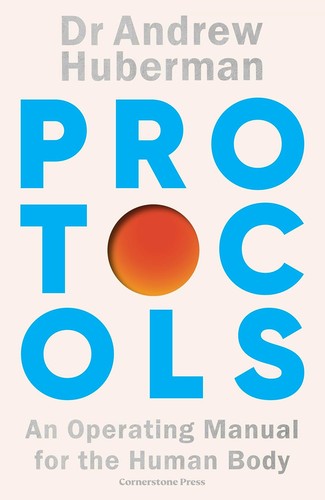
⏱ The book in 1 minute
- Protocols is Andrew Huberman's attempt to turn neuroscience and physiology research into a practical operating manual for the human body.
- The core idea is that small, specific daily actions can change how you sleep, focus, handle stress and feel.
- Recurring levers include light exposure, breathing, temperature, movement, and the timing of food and caffeine.
- The tools are meant to be tested on yourself, kept if they help, and dropped if they don't.
- Start with the basics, especially sleep and morning light, before adding anything advanced or supplements.
The big idea
Protocols argues that you have more control over how you feel and perform than you think, and that the most reliable lever is behavior, not willpower or supplements. Huberman, a Stanford neuroscientist and host of the Huberman Lab podcast, writes with science journalist Jessica Wapner. Together they turn his framework into a practical manual. The idea is that the brain and body run on systems you can deliberately nudge: circadian rhythms, arousal and calm, motivation, and adaptation to physical stress. You nudge them through small actions repeated at the right times. Light at the right hour, a consistent sleep window, how you breathe under stress, when you train, and what you eat all count. Each protocol pairs a short explanation of the underlying biology with steps you can test on yourself. Understanding why something works makes you more likely to stick with it and adjust it to your life.
Key ideas
Behavior is the first tool
Free, repeatable actions come before pills or gadgets: going outside, sleeping on schedule, moving, breathing on purpose. They act on the same systems that drugs and supplements target, often more sustainably and without side effects. If you change only one thing, change a daily behavior rather than buying a product.
Timing matters as much as the action
The same behavior can help or hurt depending on when you do it. Light, caffeine, exercise, food, and temperature all send time-of-day signals to your internal clock. A recurring theme is anchoring your day: bright light early, dim light late, and stimulants kept away from bedtime.
Sleep is the foundation for everything else
Mood, focus, metabolism, hormones, and physical recovery all depend on getting enough regular sleep. Most other protocols work better, or only work, once sleep is in order. Fix this before you optimize anything else.
You can shift your state on demand
Stress and alertness aren't just things that happen to you. Breathing patterns, physical movement, and where you put your attention can move your nervous system toward calm or toward alertness within minutes. Learning a couple of fast state-shifting tools is one of the most immediately useful takeaways.
Motivation follows biology you can manage
Drive and focus depend on brain chemistry that you can deplete through constant high-stimulation habits. You can also protect it by how you structure effort and reward. Spacing out easy pleasures and finding satisfaction in the effort itself helps keep motivation steady over time.
The body adapts to the stress you give it
Exercise and other deliberate physical challenges work because the body responds to manageable stress by getting stronger and more resilient. The key variables are dose and recovery. More is not automatically better.
Treat yourself as an experiment
Protocols are starting points, not commandments. Change one variable at a time, keep it consistent for a while, and pay attention to what actually changes. Sleep, energy, mood, and performance are your feedback signals.
A real case
One of the real examples the book uses, told in our own words.
The five-minute breathing experiment
Huberman often points to a study from his own Stanford lab, run with psychiatrist David Spiegel, as an example of putting a simple tool to a real test. Volunteers spent about five minutes a day on one of several practices, either a structured breathing pattern or mindfulness meditation, for roughly a month. The breathing pattern built around long, extended exhales, which Huberman calls cyclic sighing, produced the strongest improvement in daily mood. It also lowered participants' resting breathing rate. For Huberman, the result shows two things. Short, free and boring-sounding routines can have measurable effects. And a protocol earns its place by being checked against something else, not because it sounds good. The takeaway for readers is practical: a few minutes of slow breathing with long exhales is an easy, low-risk experiment to run during a stressful week.
What it teaches: Short, simple, tested routines can measurably shift mood and stress, so judge a tool by how it performs, not how impressive it sounds.
Chapter-by-chapter summary
Block 1 – Why protocols? Behavior as a lever on biology
The book opens with its premise: specific, repeatable actions can recruit the body's own regulatory systems. It explains why understanding the mechanism matters. When you know why a step works, you can adapt it instead of following it blindly. It also sets expectations: start with a few foundational habits, build consistency, and add complexity later.
Block 2 – Light, time of day, and the internal clock
This block covers the circadian system as the master scheduler for sleep, alertness, hormones, and mood. The practical emphasis is on getting bright light early in the day, especially natural light, and limiting bright light at night. Keeping wake time and other anchors consistent comes next. These are among the simplest protocols and have some of the widest effects.
Block 3 – Sleep: getting it, protecting it, recovering it
Here sleep is the base layer for health and performance. Expect guidance on a regular schedule, a sleep-friendly environment, and the timing of caffeine, meals, alcohol, and exercise relative to bed. It also covers what to do when you can't fall back asleep. Readers should take away a short checklist of the habits they're probably getting wrong.
Block 4 – Focus, motivation, and the reward system
This block explains how attention and drive work in the brain. It shows how modern habits can blunt them, like constant stimulation and stacking several pleasures at once. Protocols in this area deal with structuring work sessions, cutting down distractions, and keeping motivation steady by valuing effort rather than chasing rewards.
Block 5 – Stress, mood, and the nervous system
This block covers how to move between alert and calm states on purpose. It includes deliberate breathing techniques, ways to use stress productively instead of fighting it, and practices for deep rest when sleep isn't possible. The focus is on tools that work in real time, in the middle of a stressful day.
Block 6 – Exercise, physical performance, and recovery
Physical training appears both as a health tool and a performance tool. Expect a framework that balances strength and endurance work, along with the role of recovery and deliberate physical stressors such as temperature exposure. Throughout, the stress has to be dosed so the body adapts rather than breaks down.
Block 7 – Nutrition, supplements, and other substances
This block covers how food choices and meal timing affect energy and focus. It also covers where supplements and other compounds fit, if at all. The behavior-first stance means these are positioned after the basics, not instead of them. Readers should check any supplement suggestion with a doctor, especially if they take medication.
Block 8 – Building your personal operating system
The closing material is about putting it together: choosing a few protocols, fitting them into an actual schedule, and tracking results. It also covers adjusting over time. The message is that a small set of habits you keep beats a long list you abandon.
Key concepts
- Protocol
- A specific, repeatable action with a clear purpose, timing and dose, grounded in research. Examples include getting outdoor light shortly after waking or using a breathing pattern to calm down.
- Physiological sigh (cyclic sighing)
- A breathing pattern with two inhales through the nose followed by a long, slow exhale. It's used as a fast way to bring stress down in real time, or practiced for a few minutes as a daily routine.
- Morning light viewing
- Getting outdoor light into your eyes early in the day to anchor your circadian rhythm. The goal is better alertness in the morning and easier sleep at night.
- NSDR (Non-Sleep Deep Rest)
- A term Huberman coined for practices like yoga nidra or guided body scans that bring on deep relaxation while you stay awake. It's used to recover energy and focus without napping.
- Delayed caffeine
- The suggestion to wait a while after waking before your first coffee and to avoid caffeine late in the day. The point is to protect sleep and reduce the afternoon crash.
- Deliberate cold exposure
- Planned, controlled use of cold water, such as cold showers or ice baths, to raise alertness and practice handling discomfort. The dose matters, and it doesn't suit everyone.
The book in one image
- Behavior before supplements
- Timing changes the effect
- Sleep is the foundation
- Morning light sets your clock
- Breathing shifts your state fast
- Dose stress, then recover
- Test one change at a time
Who it’s for
- Huberman Lab listeners who want the core protocols organized in one place instead of scattered across hours of episodes
- People who want practical, mechanism-based habits for sleep, energy, focus, and stress, and who like knowing the why behind the how
- Self-experimenters who enjoy testing one change at a time and tracking how they feel
- Readers starting a health reset who need a clear order of priorities (light, sleep, movement, then the rest)
Who it’s not for
- Readers looking for a quick, light read; by most accounts this is a long, dense reference book
- People who want only conclusions backed by large, long-term clinical trials; some protocols extrapolate from smaller or mechanistic studies
- Anyone hoping a book will replace medical care for a diagnosed condition, sleep disorder, or mental health issue
- Readers who get overwhelmed by long to-do lists of habits and are likely to try everything at once
Our take
What works
- The behavior-first approach is sound and empowering: most of the high-impact steps (morning light, consistent sleep, regular exercise, deliberate breathing) are free and low-risk.
- Explaining the mechanism behind each protocol makes it easier to adapt advice to your own schedule instead of following rigid rules.
- It gives podcast fans a structured, searchable version of ideas that were previously spread across very long episodes.
- Its scope means you can use it as a reference: pick the area you're struggling with and go straight there.
What doesn’t
- Huberman's broader work has been criticized by scientists and journalists for sometimes stretching findings from small, animal, or short-term studies into confident everyday advice. Readers should keep that in mind with the more specific protocols.
- The volume of recommendations can feel like a second job; without discipline about priorities, it's easy to over-optimize.
- Some advice assumes flexible schedules and access to things like outdoor time, gyms, or temperature exposure, which not everyone has.
- The author's public profile and past controversies may color how some readers approach the book, even when the advice itself is reasonable.
Compared with similar books
If you want longevity strategy grounded in clinical medicine, Peter Attia's Outlive is more systematic about risk and long-term disease, while Protocols is more about day-to-day state and performance. On sleep specifically, Matthew Walker's Why We Sleep goes deeper on one topic but has also been criticized for overstatement. For the skill of actually sticking to new routines, James Clear's Atomic Habits is the better companion: Protocols tells you which habits matter biologically, and Atomic Habits helps you keep them.
Common mistakes when applying it
✗ Trying to adopt every protocol at once and burning out within a week.
How to avoid it: Choose one or two tools that target your biggest problem, usually sleep. Run them for a few weeks before adding more.
✗ Treating protocols as a replacement for medical care.
How to avoid it: Use them alongside professional advice, not instead of it. That matters most for insomnia, anxiety, depression or heart conditions, and before trying cold exposure or supplements.
✗ Jumping to supplements and gadgets before fixing the basics.
How to avoid it: Put light, sleep timing, movement and caffeine habits in place first. They cost little and drive most of the results.
✗ Following timing rules so rigidly that they become a new source of stress.
How to avoid it: Treat timings as defaults, not laws. If you miss your morning light or have coffee early, just get back on track the next day.
✗ Assuming that what works in a study will work the same way for you.
How to avoid it: Track a simple signal, like sleep quality, energy or mood, for a couple of weeks. Keep what clearly helps and drop the rest.
Frequently asked questions
What is Protocols by Andrew Huberman about?
It's a practical guide to using everyday behaviors (light exposure, sleep timing, breathing, exercise, nutrition, and how you structure effort) to improve mood, energy, focus, and physical health. Each protocol pairs a short explanation of the biology with steps you can try on yourself.
Is Protocols worth reading? An honest review
Yes, if you want an organized, mechanism-based reference for daily health habits, especially if you already like the Huberman Lab podcast. It's less useful if you want only conclusions from large clinical trials or a short, easy read. The best approach is to start with the foundational protocols (light, sleep, movement) and ignore the rest until those are steady.
Is the book just a repackaged version of the Huberman Lab podcast?
It covers many of the same themes, but in a structured book format, co-written with science journalist Jessica Wapner. The main advantage over the podcast is organization: the protocols are grouped by goal, so you can find what you need without listening to multi-hour episodes.
When did Protocols by Andrew Huberman come out?
Protocols: An Operating Manual for the Human Body was published in 2025. It's available in hardcover, ebook, and audiobook formats from major US retailers, and many public libraries carry it.
Is there a free PDF of Protocols?
Sites offering free PDF or EPUB downloads of the book are generally unauthorized and can carry malware. Legitimate low-cost options include borrowing the print, ebook, or audiobook from your public library (often through apps like Libby) or reading a summary like this one first to decide if it's for you.
What's the single best protocol to start with?
The idea that runs through the whole book is to fix your daily rhythm first. Get bright, ideally outdoor, light soon after waking, keep a consistent wake time, and dim the lights in the evening. It costs nothing, takes minutes, and supports sleep, mood, and energy, which makes every other protocol easier.