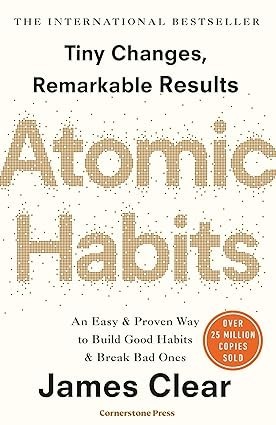
⏱ The book in 1 minute
- Small habits compound: getting 1% better each day adds up to remarkable results over time.
- Build systems instead of chasing goals, because you rise or fall to the level of your systems.
- Lasting change starts with identity: every action is a vote for the type of person you want to become.
- To build a good habit, make it obvious, attractive, easy, and satisfying; to break a bad one, invert those four rules.
- Shape your environment and shrink new habits to two minutes so showing up becomes nearly automatic.
The big idea
Lasting change rarely comes from one big decision. It comes from small behaviors repeated so often that they compound, the way interest does in a savings account. James Clear argues that if your results aren't improving, the problem usually isn't your willpower or your goals. It's your system: the cues, environment, and routines that shape what you do automatically. He breaks every habit into a four-step loop (cue, craving, response, reward) and turns it into four practical laws: make good habits obvious, attractive, easy, and satisfying, and flip each law to break bad ones. Underneath the tactics is a bigger shift. The most durable habits come from identity. Instead of chasing an outcome like "run a marathon," you focus on becoming "a runner," and every small action counts as a vote for that person.
Key ideas
Small gains compound, but slowly at first
Improving by about 1% a day adds up to enormous change over a year, and getting slightly worse compounds just as hard in the other direction. The catch is that early progress is mostly invisible. Clear calls the frustrating stretch where effort hasn't paid off yet the "plateau of latent potential." Results often show up all at once after a long buildup, so judge your habits by their direction, not by this week's results.
Systems beat goals
Winners and losers often share the same goals, so the goal itself can't be what separates them. What matters is the system: the daily processes that move you forward. A goal is satisfied once and then gone, while a system keeps working. Set the direction with goals, then put your energy into the routine.
Build habits around who you want to become
The deepest layer of change is identity, not outcomes. Ask what kind of person would get the result you want, then prove to yourself in small ways that you are that person. Each workout is a vote for "I'm someone who exercises." You don't need a unanimous vote, just a growing majority.
The habit loop and the four laws
Every habit runs through cue, craving, response, and reward. Each step maps to one law. Make it obvious (cue), make it attractive (craving), make it easy (response), and make it satisfying (reward). To break a bad habit, invert them: make it invisible, unattractive, difficult, and unsatisfying.
Design your environment instead of relying on willpower
People who seem disciplined often just face fewer temptations. Put cues for good habits in plain sight, such as a water bottle on your desk or a book on your pillow. Remove the cues for bad ones, like keeping your phone in another room. Tie new habits to a specific time and place ("I will [behavior] at [time] in [location]") or stack them onto something you already do ("After I pour my coffee, I will...").
Reduce friction and use the two-minute rule
Habits form through repetition, not time, so the main job is to make showing up easy. Shrink any new habit to a version that takes two minutes or less. "Read before bed" becomes "read one page." Get good at starting first, then build up. Add friction to bad habits so they take more steps.
Make it satisfying now, and never miss twice
We repeat what feels good right away, even when the payoff comes much later. Give good habits an immediate reward, track them visually (a calendar of X's, clips moving between jars), and use an accountability partner or a written contract to make bad habits costly. If you slip, get back on track the next time. One missed day is an accident. Two starts a new pattern.
A real case
One of the real examples the book uses, told in our own words.
British Cycling and the Power of Marginal Gains
For roughly a century, British pro cycling was a non-factor, so unimpressive that at least one top bike maker reportedly didn't want its products associated with the team. Then Dave Brailsford took over as performance director with an unusual plan: instead of hunting for one big breakthrough, find hundreds of tiny improvements of about 1% each. His staff redesigned bike seats for comfort, tested fabrics in a wind tunnel, and had riders wear electrically heated overshorts to keep their muscles warm. They went further, into areas most coaches ignore: identifying the pillow and mattress that gave each rider the best sleep, teaching athletes proper hand washing to avoid catching colds, and painting the inside of the team truck white so dust that could affect the bikes would be easy to spot. None of these changes looked important alone. Together, they transformed the team, which went on to dominate Olympic track cycling and win the Tour de France multiple times within a few years.
What it teaches: Many tiny improvements, stacked and sustained, can produce results no single big change could.
Chapter-by-chapter summary
Introduction: The author's own reset
Clear explains how he started using small habits during a long recovery from a serious injury he suffered playing baseball in high school. That experience, plus years of writing about habits, shaped the practical framework the book lays out.
Chapter 1: Why tiny changes matter so much
Habits compound over time, for better or worse. Progress isn't linear, so expect a long, quiet stretch before results show up. Clear makes the case that systems, not goals, are what drive results, and he uses the turnaround of British cycling as an example of many small improvements adding up.
Chapter 2: Habits and identity shape each other
Clear describes three layers of change: outcomes, processes, and identity. Lasting change starts with deciding who you want to be and backing that up with small wins. Your habits then reinforce the identity, and the identity makes the habits stick.
Chapter 3: The four-step habit loop
Every habit follows cue, craving, response, and reward. Clear turns this loop into four laws of behavior change, one for each step, plus their inversions for breaking bad habits. The rest of the book follows this structure.
Chapters 4–7: Law 1, make it obvious
You can't change what you don't notice, so start by auditing your current habits with a simple scorecard. Make new habits concrete with implementation intentions (behavior, time, place) and habit stacking. Shape your surroundings so good cues are visible and bad ones are out of sight. Self-control works best when you avoid temptation rather than fight it.
Chapters 8–10: Law 2, make it attractive
Anticipating a reward is what drives action, so link habits you need to do with things you want to do (temptation bundling). The groups we belong to strongly shape our behavior, so spend time with people for whom your desired habit is normal. To weaken bad habits, reframe them by focusing on what you gain from avoiding them.
Chapters 11–14: Law 3, make it easy
Repetition matters more than planning or perfection, so take action instead of only preparing. People naturally go with the path of least effort, so reduce the steps for good habits and add steps for bad ones. The two-minute rule makes starting nearly effortless. One-time choices, such as buying better tools or setting up automatic savings, can lock in good behavior for the long term.
Chapters 15–17: Law 4, make it satisfying
We repeat what feels rewarding right away. Add immediate rewards to habits whose benefits come later, and track your progress so it's visible. When you miss a day, recover quickly instead of quitting. Make bad habits painful in the moment, for example through an accountability partner or a habit contract with real consequences.
Chapters 18–20: Advanced tactics
Genes don't decide your destiny, but they point to where you'll have an edge, so pick habits and arenas that suit your natural strengths. Motivation stays high when challenges sit just at the edge of your current ability (the Goldilocks rule). Mastery requires pushing through boredom. Habits also have a downside: once something is automatic, you stop paying attention, so build in regular reflection and review.
Conclusion: Results that last
No single habit transforms your life. Many small improvements, layered on top of each other, add up to remarkable results. The real goal is a cycle of continuous improvement, not a finish line.
Key concepts
- Atomic habit
- A small, easy routine that is also a building block of a bigger system. Like an atom, it is tiny on its own but powerful when combined with others over time.
- The Four Laws of Behavior Change
- Make it obvious, make it attractive, make it easy, and make it satisfying. To break a bad habit, invert them: make it invisible, unattractive, difficult, and unsatisfying.
- Identity-based habits
- Building change around who you want to become rather than what you want to achieve. Each repetition is evidence that reinforces a new self-image, such as being a person who never misses a workout.
- Habit loop (cue, craving, response, reward)
- The four steps behind every habit: a cue triggers a craving, which drives a response, which delivers a reward. The Four Laws map directly onto these four stages.
- Habit stacking
- Attaching a new habit to one you already do, using the formula after I do current habit, I will do new habit. The existing routine becomes the trigger.
- Implementation intention
- A specific plan that states the behavior, time, and location, like exercising at 7 a.m. in the garage. Vague intentions fail; specific ones get done.
- Two-Minute Rule
- Scale any new habit down to something that takes two minutes or less, like putting on running shoes instead of running five miles. The goal is to master showing up before trying to improve.
- Plateau of Latent Potential
- The stretch where effort seems to produce no visible results because progress is building beneath the surface. Most people quit here, right before the compounding becomes visible.
The book in one image
- 1% better daily compounds
- Fix the system, not the goal
- Every action is a vote for who you are
- Make it obvious
- Make it attractive
- Make it easy: two minutes to start
- Make it satisfying, and never miss twice
Who it’s for
- People who keep setting goals (fitness, writing, saving, studying) but can't stay consistent past the first few weeks
- Readers who want a practical, step-by-step method rather than motivational talk
- Managers, coaches, and parents who want to design environments that make good behavior easier for others
- Anyone new to the topic who wants one clear, well-organized book on habits
Who it’s not for
- Readers who have already read a lot about habit science (Duhigg, Fogg, Newport), since much of the material will feel familiar
- People dealing with clinical addiction, depression, or ADHD, who need professional support beyond general habit tactics
- Readers who want deep research or academic rigor rather than accessible, anecdote-driven explanations
Our take
What works
- The four laws, plus their inversions, form a framework you can remember and use right away on almost any habit
- The identity-based approach goes beyond tactics and explains why some changes stick while others fade
- Very actionable: habit stacking, the two-minute rule, and environment design take minutes to try
- Clear, tight writing with summaries at the end of each chapter that make it easy to review
What doesn’t
- Many ideas are repackaged from existing research and earlier books, so experienced readers won't find much that's new
- Some stories are hand-picked success cases and illustrate more than they prove
- Gets repetitive in the middle sections, and the book could be shorter
- Says little about structural barriers like time, money, and stress, or about habits that call for clinical help
Compared with similar books
Compared with Charles Duhigg's The Power of Habit, Atomic Habits is less narrative and far more hands-on. Duhigg explains why habits work through stories about people and companies, while Clear gives you a toolkit. BJ Fogg's Tiny Habits covers similar ground (start tiny, anchor to existing routines) but focuses more on emotions and celebrating small wins, and it comes from a researcher who designed the method himself. If you want to understand habits, read Duhigg. If you want to change one this week, read Clear. If Clear's version still feels like too much effort, try Fogg.
Common mistakes when applying it
✗ Setting ambitious goals and expecting them to change your behavior.
How to avoid it: Keep the goal for direction, but put your energy into the daily system: the specific routines, times, and places that make progress automatic.
✗ Starting too big because motivation is high on day one.
How to avoid it: Apply the Two-Minute Rule. Make the starting version almost embarrassingly small and only scale up once showing up feels automatic.
✗ Treating a missed day as proof you've failed and giving up.
How to avoid it: Follow the never-miss-twice rule. Missing once is an accident; missing twice starts a new habit. Get back on track at the very next opportunity.
✗ Relying on willpower while leaving your environment unchanged.
How to avoid it: Redesign your space: put cues for good habits in plain sight, add friction to bad ones (unplug the TV, keep snacks out of the house), and use separate spaces for separate activities.
✗ Trying to overhaul many habits at once.
How to avoid it: Pick one keystone behavior, attach it to an existing routine with habit stacking, and track it visibly before adding another.
Frequently asked questions
What is Atomic Habits about in one sentence?
Big results come from small habits repeated consistently, and you can build good ones (and break bad ones) by making them obvious, attractive, easy, and satisfying, while focusing on who you want to become rather than only on the outcome.
What are the key points of Atomic Habits?
Small improvements compound over time. Systems matter more than goals. Identity-based habits last longer. Every habit follows a cue-craving-response-reward loop. The four laws of behavior change (and their inversions) give you a lever at each step. Environment design, the two-minute rule, habit tracking, and "never miss twice" are the main practical tools.
What's on an Atomic Habits cheat sheet?
To build a habit: make it obvious (implementation intentions, habit stacking, visible cues), make it attractive (temptation bundling, joining a group where the habit is normal), make it easy (reduce friction, two-minute rule, automate), and make it satisfying (immediate rewards, habit tracking, never miss twice). To break a habit, do the reverse: make it invisible, unattractive, difficult, and unsatisfying.
What happens in chapter 1 of Atomic Habits?
Chapter 1 explains why tiny changes matter. Getting about 1% better each day compounds into large gains over a year. Progress often stays invisible for a while before results appear (the plateau of latent potential). Clear also argues that you get results from your systems, not from your goals.
Is Atomic Habits worth reading?
Yes, if you're new to habit-building or want a practical method you can apply right away. It's one of the clearest, most usable books on the topic. If you've already read The Power of Habit or Tiny Habits, expect a lot of overlap. A chapter-by-chapter summary may give you most of the value.
How long does it take to build a habit according to Atomic Habits?
Clear avoids promising a fixed number of days. His point is that habits form through repetition, not time. What matters is how many times you perform the behavior, which is why making it easy to repeat counts for more than waiting out a calendar.